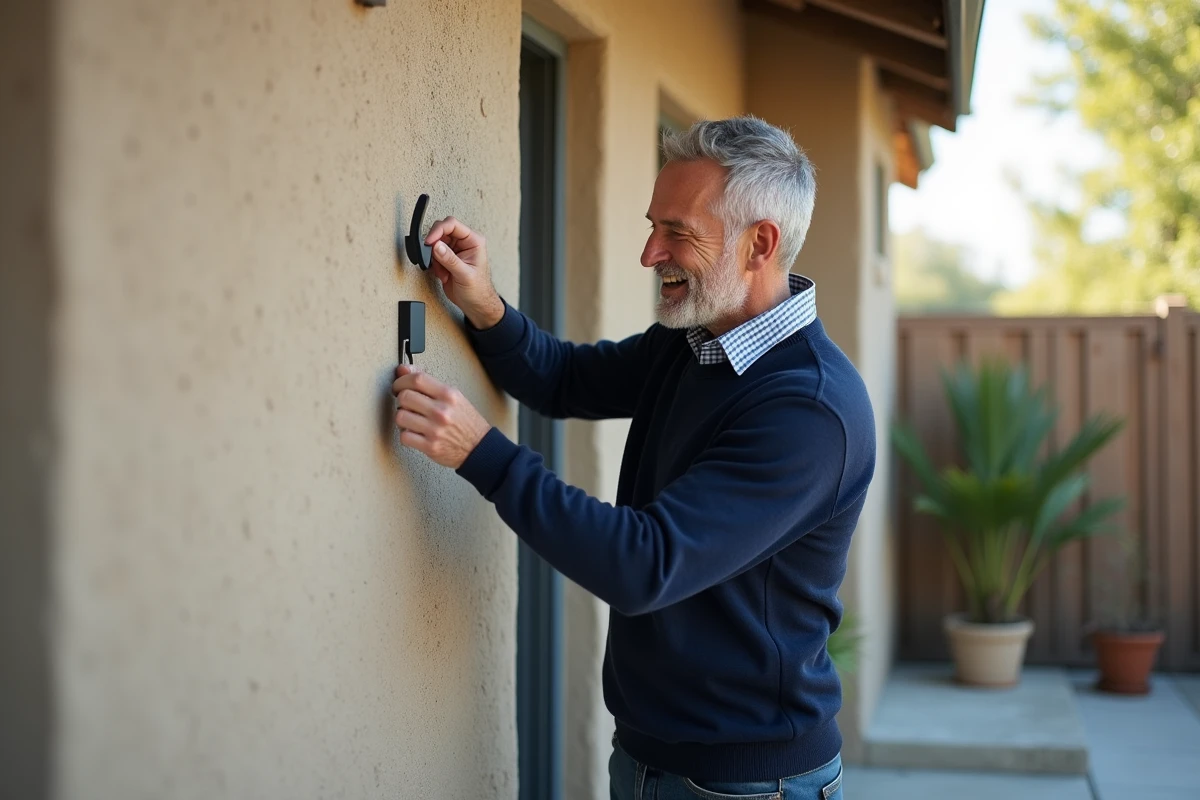
Some wall surfaces stubbornly resist traditional fastening methods. Plaster, known for being difficult to tame, presents a particular challenge: most universal adhesives fail on these textures that are nonetheless ubiquitous in many interiors.
However, there are proven solutions and lesser-known tips that allow you to hang significant loads without drilling, while preserving the integrity of the support. The choice of product, surface preparation, and weight distribution play a crucial role in the success of the operation.
The Challenges of Plaster: Why Fixing Without Drilling Is Not So Simple
The plaster wall offers no favors. Its grainy texture, sometimes unpredictable, undermines standard glues and stands up to adhesives that perform well on smooth walls. On a polished surface or drywall, installation poses no problem. But as soon as the plaster’s reliefs come into play, things get complicated. When you want to preserve the condition of a wall, you can’t settle for a one-size-fits-all solution: you need to aim accurately, with products suited to these unforgiving surfaces.
Before diving in, it is essential to consider several parameters: the exact nature of the support, the weight of what you want to hang, and the room’s environment. You cannot skip preparation: meticulous cleaning, impeccable drying, and thorough degreasing are necessary. A stiff brush is recommended, as dust and residues, invisible to the naked eye, are enough to cause the fastening to fail.
Fixing on plaster without drilling: the idea is appealing, but success requires finding the right balance between adhesive performance and wall quality. Manufacturers have developed specific products capable of infiltrating the crevices of the plaster and holding despite its porosity. However, when it comes to heavy loads, even the best no-drill systems show their limits. Professionals emphasize: underestimating the weight of the object risks seeing everything fall a few days after installation.
Here are the parameters to closely monitor before choosing a method:
- Wall Surface: the more pronounced the relief, the more meticulously the support must be prepared.
- Type of Object: by distributing the load well and prioritizing lightweight objects, you increase the chances of success.
- Ambient Conditions: humidity, temperature fluctuations, all of this works against the adhesive.
In summary, a fixation on plaster without drilling resembles a negotiation: protecting the wall while ensuring that what you hang won’t end up on the floor. Effective advice relies on experience, common sense, and sometimes a few trials before finding the best solution.
What Solutions Really Hold on a Plaster Wall? Overview of Reliable Options
To successfully achieve a fixation without drilling on a plaster wall, there are several families of products that cover most needs. The double-sided adhesive, for example, is a reference for heavy objects: some specially designed models can support several dozen kilos and adapt to both humid rooms and outdoor conditions. Their dense foam compensates for the irregularities of the plaster, provided that the installation is flawless.
For those who like to change their decor or move their frames, hook-and-loop strips are ideal. They can be removed and repositioned easily, perfect for spaces that frequently evolve. For more modest items, adhesive hooks (up to 1 kg) and adhesive nails (up to 2 kg) allow for quick installation, without tools, and especially without damaging the wall.
Another option for the creative: magnetic paint. It transforms the wall into an interactive board, handy for displaying photos, notes, or lightweight accessories, whether in a bedroom, office, or kitchen. Adhesive tabs are suitable for small frames and posters, while mounting glue or epoxy putty meet the extreme conditions of rough walls or raw concrete.
Here’s an overview of the main solutions used on plaster:
- Double-sided adhesive: for heavy loads, provided the wall is prepared carefully.
- Hook-and-loop strips: ideal for evolving decor and removable frames.
- Adhesive hooks and nails: for medium-weight objects, to be applied in seconds.
- Magnetic paint: perfect for fixing photos and lightweight accessories using magnets.
- Glue/putty, epoxy putty: suitable for very rough materials and significant loads.
As for the reinforced suction cup, it maintains its place on smooth surfaces, but on plaster, its effectiveness remains very relative. Each time, it is a matter of crossing three criteria: the chosen solution, the weight of the object, and the texture of the wall. This is the winning combination for stable fixations, without holes or unpleasant surprises.
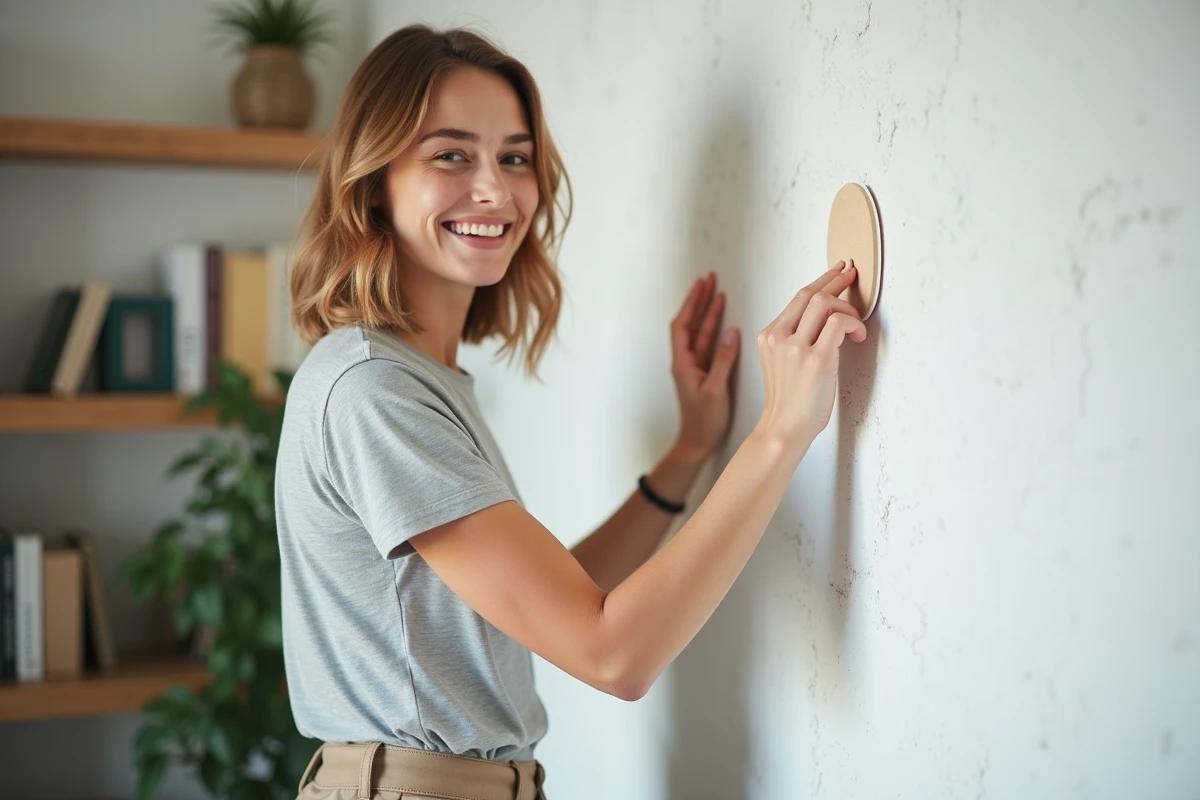
Choosing Wisely According to Weight and Type of Plaster: Practical Tips and Professional Advice
Given the variety of plasters and the diversity of objects to hang, successfully achieving a fixation without drilling on a grainy support requires a tailored approach. It all starts with a careful examination of the wall: fine or accentuated plaster, plaster, concrete, brick, stone… Each material has its logic and guides you toward the most suitable solution.
The weight of the object remains the starting point. For anything weighing less than 1 kg, adhesive hooks are more than sufficient, whether for hanging light decor or a small utensil. Between 1 and 2 kg, it is better to opt for adhesive nails. Beyond that, only very high-performance strips, mounting glues, or epoxy putties designed for hard surfaces guarantee solid support. Adhesive tabs are helpful for frames or photos that you want to be able to easily remove without leaving a trace.
The preparation of the support makes all the difference. Cleaning, degreasing, thorough drying: every step counts. A damp or greasy wall, and the adhesive will never hold. In kitchens or bathrooms, it is better to choose products compatible with humidity and resistant to temperature fluctuations. If the plaster is very irregular, one trick is to combine a mounting putty and apply prolonged pressure during installation.
To succeed brilliantly, here are a few guidelines to keep in mind:
- Prepare each surface: meticulous cleaning, suitable brush, complete drying.
- Assess the precise weight of the object to be hung.
- Adapt the solution to the relief of the plaster: the more pronounced the grain, the more you need to rely on the adhesive’s strength.
Those who master these steps act like pros: careful observation of the wall, product selection based on context, rigorous application. It is this demand that transforms a risky attempt into a reliable fixation. And if sometimes it requires starting over, that’s the price to pay to avoid damaging your walls and to ensure that everything stays in place, even on a stubborn plaster. Nothing is more satisfying than seeing an object remain in place, defying gravity and the whims of the support.