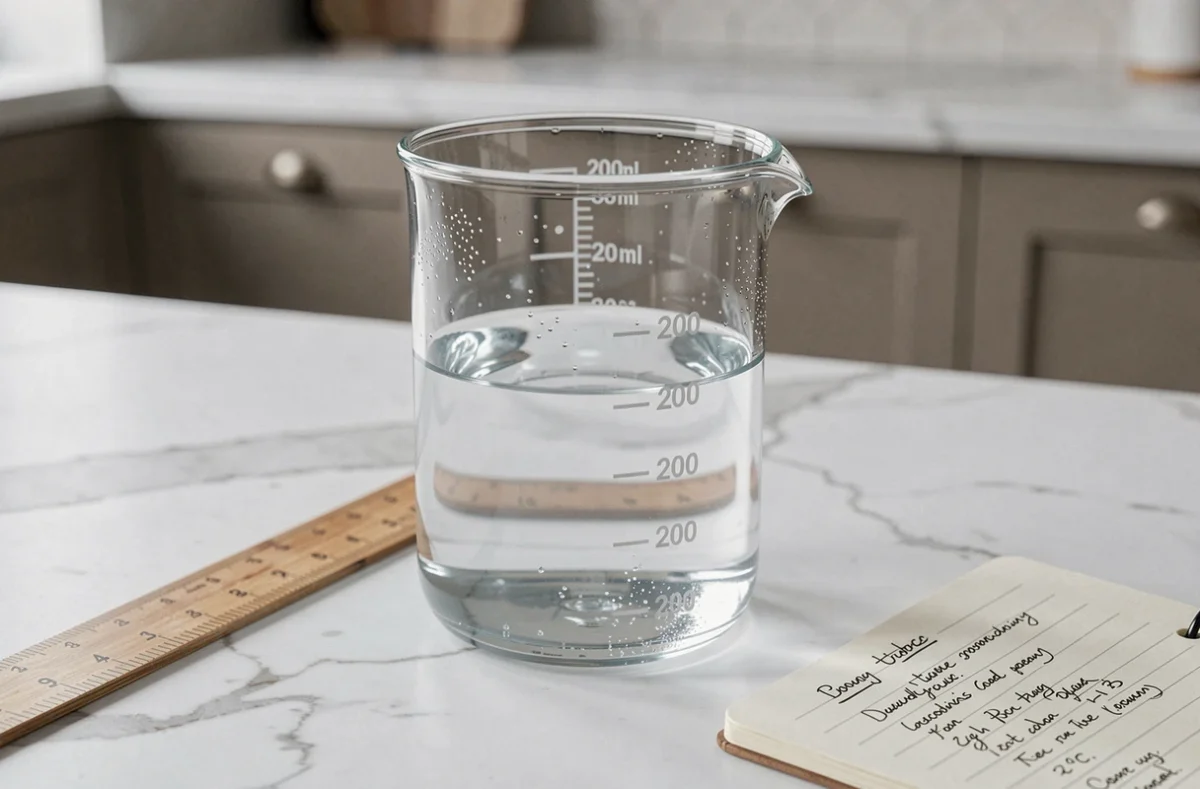
In the kitchen and in the laboratory, 200 ml of water is a common volume. The conversion is straightforward: 200 ml is equivalent to 20 cl and 0.2 litres. The formula is based on the decimal metric system, where each volume unit is derived from the previous one by a factor of 10. But beyond the calculation, the real challenge is measuring those 200 ml accurately, especially without a graduated measuring cup.
Scales or graduated containers: how accurately can you measure 200 ml?
Most pages about conversions stop at the mathematical result. The problem arises when you pour the liquid into a container and read the markings.
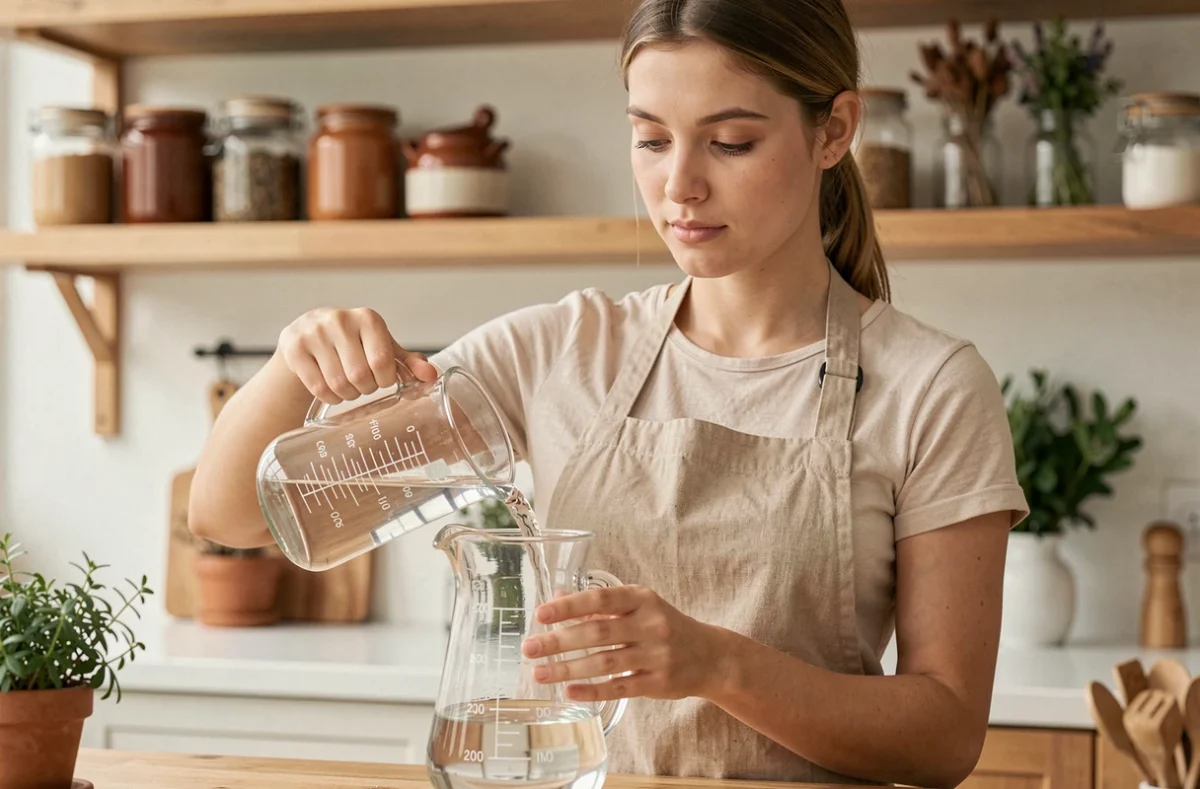
When a liquid wets the sides of a container—as water does—its surface forms a curve called a meniscus. Laboratory practice requires you to position your eye exactly level with the marking and read the bottom of the meniscus, not the top. Looking from just a few centimetres above or below can distort the reading due to parallax.
The shape of the container also matters. In a wide container, a small error in reading the liquid level corresponds to a larger volume difference than in a narrow one, because its cross-sectional area is greater. A flared measuring cup will therefore be less accurate than a narrow graduated cylinder when measuring exactly 200 ml.
An alternative is to weigh the water on a kitchen scale. The relationship between the volume and mass of water is a very reliable approximation for cooking, but it depends in part on the liquid’s temperature.
In practice, for tap water at room temperature, 200 g on the scale corresponds to about 200 ml. Some kitchen scales have a display mode in millilitres specifically calibrated for water or milk. Check which function is selected, as grams and millilitres are not interchangeable for all ingredients.
Converting 200 ml of water to cl and litres is therefore a simple calculation, but the actual accuracy depends on the measuring tool you choose and how you use it.
Converting ml, cl and litres: the decimal logic behind 200 ml
The metric system links volume units through powers of 10. Converting from one unit to another simply means moving the decimal point.
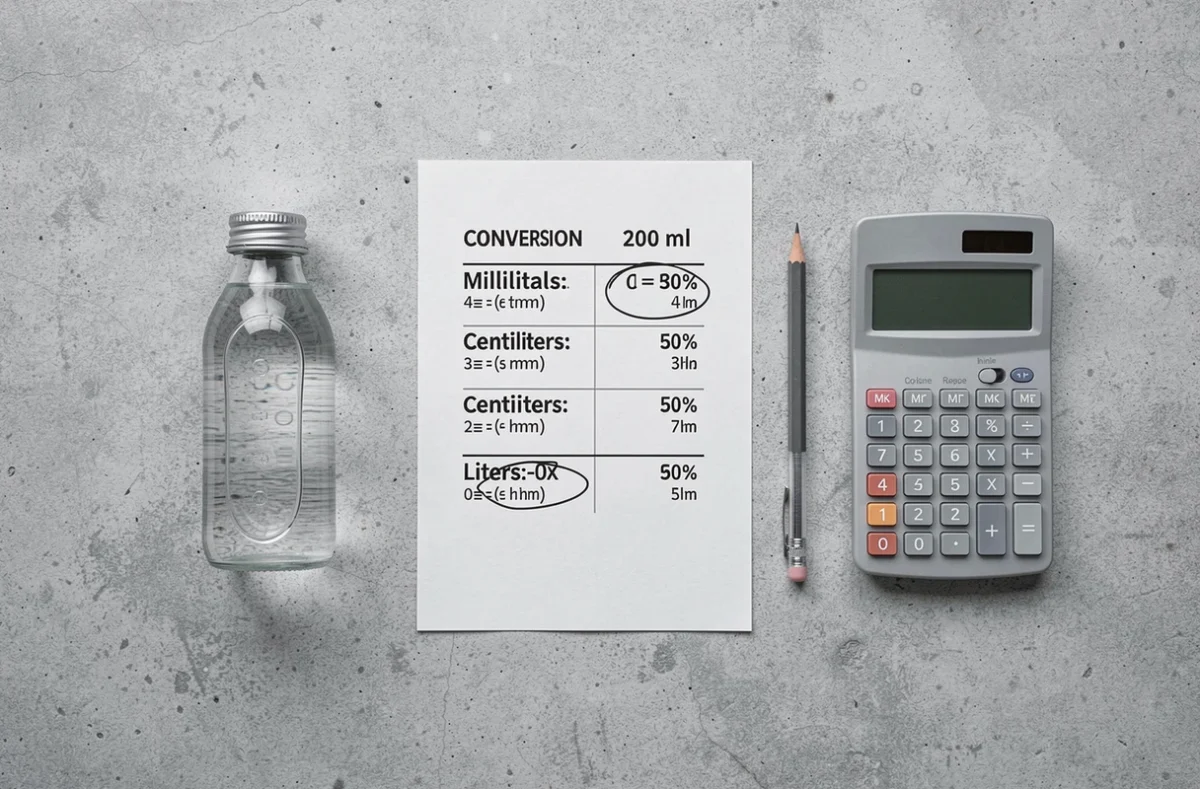
- To convert millilitres to centilitres, divide by 10. Here: 200 ÷ 10 = 20 cl.
- To convert millilitres to litres, divide by 1,000. Here: 200 ÷ 1,000 = 0.2 litres.
- To convert centilitres to millilitres, multiply by 10. Here: 20 × 10 = 200 ml.
This works the same way for any value. It does not depend on the ingredient, temperature or liquid density: this is a pure volume conversion, not a mass conversion.
Conversion table for 200 ml
| Unit | Value |
|---|---|
| Millilitres (ml) | 200 |
| Centilitres (cl) | 20 |
| Decilitres (dl) | 2 |
| Litres (l) | 0.2 |
French recipes often give volumes in centilitres (20 cl of milk, 15 cl of cream). Anglo-Saxon recipes tend to use millilitres or cups. Knowing how to convert between them helps prevent measuring errors when adapting a recipe.
How to measure 200 ml without a measuring cup: practical methods
Not having a measuring cup on hand is common. Several household items can help you estimate 200 ml with an acceptable margin of error for cooking.
A standard mustard glass holds about 20 cl, or exactly 200 ml. Filled to the brim, it gives you close to the volume you need. Two coffee cups holding 10 cl each will give you the same amount.
A tablespoon holds about 15 ml. You would therefore need just over 13 level tablespoons to reach 200 ml. This method is tedious and small errors add up with every spoonful.
Comparing a kitchen scale with a graduated measuring cup
A kitchen scale placed on a stable surface and tared with the empty container gives a repeatable measurement. For water, aiming for 200 g is accurate enough to measure 200 ml for almost any home recipe.
A graduated measuring cup has the advantage of showing the volume directly in millilitres or centilitres. Its accuracy depends on two factors: the spacing between the markings (the closer together they are, the harder they are to read) and the meniscus-reading technique described above. A narrow measuring cup with widely spaced markings will be more reliable than a wide one.
When there is little room for error, such as in baking or when preparing baby formula, a scale is the most consistent tool. For soup or sauce, a mustard glass is more than adequate.
Water volume and mass: why the relationship is not exact
Saying that 200 ml of water weighs 200 g is a convenient shortcut. The physical reality is more nuanced.
The mass of a given volume of water depends on its temperature. Cold water is slightly denser than hot water. For cooking, the difference is negligible: just a fraction of a gram for 200 ml. But in pharmaceutical or laboratory settings, the liquid’s temperature matters.
Oil, milk and syrup have different densities from water. 200 ml of oil weighs less than 200 ml of water, while 200 ml of honey weighs considerably more. You therefore cannot apply the volume-to-mass conversion to different ingredients without checking their density.
That is why some digital scales offer separate modes for water, milk and flour. Using the “grams” mode to measure a volume in millilitres only works correctly for water, and even then, it relies on an approximation that varies with temperature.
Converting 200 ml to 20 cl or 0.2 litres is an exact calculation as long as you are talking about volume. The challenge begins when you need to measure that volume accurately or convert it to mass. For everyday cooking, a mustard glass or a scale tared to 200 g will give you a reliable result. For more precise measurements, the choice of container and the way you read it make all the difference.