The French health record, updated in January 2025, now lists no screen exposure before age 3 as an official guideline, including screens playing in the background. Between ages 3 and 6, only occasional, supervised use is recommended.
These guidelines also apply to adults’ habits around children: avoid screens before bedtime and reduce your own screen time when interacting with your child. This framework changes things for families looking to support their child’s development every day.
Screens and child development: managing inconsistencies between daycare, school and home
Group childcare settings follow an explicit ban on screens before age 3. No tablets or TV playing in the background at daycare. The rules are clear.
At home, reality often looks different. Preparing a meal with a cartoon playing in the background, a family video call, a parent checking messages during free play: the digital environment at home does not match the rules of the childcare setting.
This inconsistency is not insignificant. A child exposed to different rules in different places may struggle to internalize a consistent framework. The guidelines in the health record do not focus solely on a child’s screen time; they also address the attention an adult can give when a child is present. A parent scrolling while playing with their child reduces the quality of verbal interaction, even if the child is not looking at the screen.
We recommend establishing one consistent guideline that applies everywhere: no screens during meals or bedtime routines, wherever you are. This basic rule avoids negotiations and gives children a clear, consistent point of reference.
It is also worth remembering that associations between screens and development do not prove a cause-and-effect relationship. They vary depending on the child’s age, the content watched and the activities that screen time replaces. This point, highlighted by an Inserm researcher, makes it possible to follow preventive guidelines without being alarmist.
For more guidance at every age, Bébé Magique’s advice for children offers additional recommendations tailored to each stage of development.

Screen-free activities: consistency matters more than quantity
A long painting session on Saturday does not make up for a week with few interactions. Child development depends on the daily repetition of a variety of small activities.
The goal is not to organize elaborate activities. The most formative tasks are ordinary ones: pouring water from a pitcher, buttoning a cardigan, sorting socks into pairs. These tasks engage fine motor skills, coordination and sequential reasoning without requiring any special equipment.
Everyday activities with strong developmental benefits
- Helping with age-appropriate household tasks (setting the table, watering a plant): builds a sense of responsibility and gross motor skills in a real-life context
- Unstructured free play with everyday objects (boxes, fabric, kitchen utensils): encourages imagination and problem-solving without adult instructions
- Making shared reading part of the routine, even for five minutes before bed: builds vocabulary and narrative comprehension, and strengthens attachment
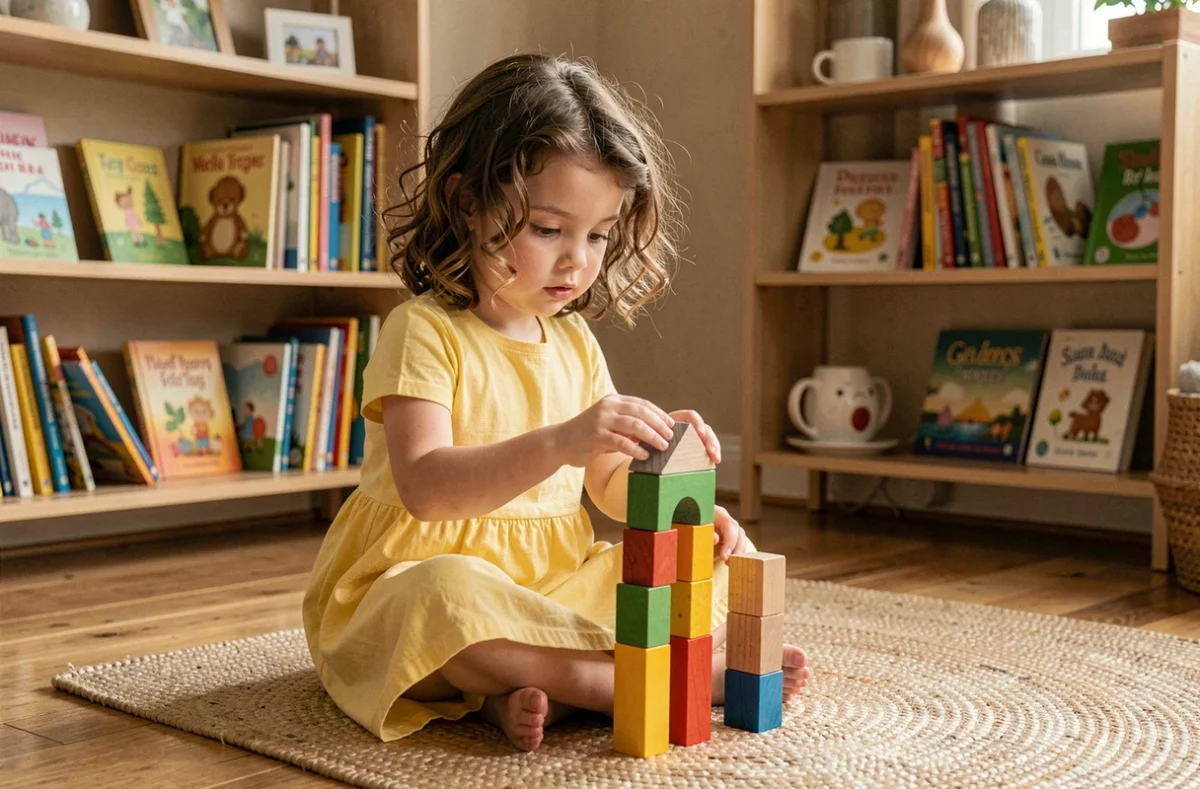
- Building or stacking games: develop hand-eye coordination and spatial awareness
The key is to weave these activities into the flow of the day, rather than setting aside a separate slot labeled “educational activity.”
Children’s confidence and independence: the parenting approach that holds them back or helps them thrive
A child who is never allowed to fail does not learn how to correct their mistakes. The least helpful approach is to step in as soon as an obstacle appears. Tying a shoe takes time at age 4, and the result will be imperfect. Taking over sends a clear message: you can’t do it.
Independence develops in stages. Each stage requires adults to accept a period of clumsiness. A child who spills their drink while pouring it themselves is going through a normal stage of motor development, not making a mistake that needs correcting.
How to respond to frustration
When a child struggles with a task, describing what they are doing (“you’re trying to fasten the top button”) is better than doing it for them or offering empty praise. A factual description acknowledges their effort without making them dependent on approval.
Excessive generic praise (“well done, that’s great”) can have a documented paradoxical effect: children may eventually act to get a reaction from an adult rather than for their own sake. Praising specific effort rather than the result helps build intrinsic motivation.

Consistency between adults: the overlooked factor in child development
Every day, a child moves between several caregivers: parents, grandparents, a childminder or a teacher. When rules vary dramatically from one adult to another, children do not develop flexibility; they develop anxiety. They spend their energy figuring out what is expected of them instead of exploring.
Perfect consistency is unrealistic, and it is not the goal. What matters is having a core set of rules that stays the same everywhere: similar bedtimes, non-negotiable physical boundaries (for safety) and a shared approach to strong emotions (acknowledge anger without giving in or punishing).
Other things can vary. Children understand perfectly well that Grandma allows an extra cookie as long as the fundamentals stay the same. The problem arises when the key rules themselves change depending on who they are with.
Communication between caregivers about three or four non-negotiable rules is enough to create a clear framework. There is no need for a comprehensive parenting protocol: a few clear, consistent guidelines give children the security they need to take risks, try new things and make progress every day.