One in two light fixtures installed in France now uses LED technology, yet the majority of households still ignore the exact impact of the color rendering index on the atmosphere of a room. The choice of luminous flux does not follow any universal standard and varies greatly depending on the function of the space.
Faced with the abundance of models, consumers often find themselves at a loss. An energy-efficient LED bulb can, on the other hand, distort colors or create a light that is too uniform, almost clinical. The market is flooded with references, making it difficult to navigate between color temperatures, varying powers, and styles suited to each room in the house.
LED lighting, an essential asset for a modern interior
Illuminating a room is no longer just about chasing away shadows: today, light shapes the ambiance, highlights contours, showcases decor, and enhances comfort. The LED, discreet yet powerful, has changed the game. With high-efficiency bulbs, elegant fixtures, and connected solutions, LED is everywhere. It consumes up to 80% less energy than old bulbs, with a lifespan that can reach 50,000 hours, allowing you to forget about changing bulbs for years.
Choosing your LED lighting is not something to improvise. A few simple rules can help avoid missteps. First, adapt the color temperature to the room:
- For the living room and bedroom, opt for warm light, between 2700 and 3000 K: the atmosphere gains in softness.
- In the kitchen or office, prefer a neutral white, between 3500 and 4100 K, which promotes concentration and efficiency.
- For the bathroom or dressing room, aim for a cool white (5000 to 6500 K): colors appear truer, and the complexion looks less dull.
The color rendering index (CRI) is crucial. A CRI of 80 and above is sufficient for daily use, but to appreciate the accuracy of tones in demanding spaces like the dressing room or bathroom, prioritize a CRI above 90.
On the solutions side, yoolight.fr offers a range of fixtures where performance, aesthetics, and reliability go hand in hand. Pendants, ceiling lights, recessed spots, or table lamps: each type of fixture has its place and mission. LED lighting thus establishes itself as the discreet yet effective ally of contemporary interiors, provided that each component is chosen wisely.
What criteria should be prioritized when choosing fixtures suited to each room?
Each space in the home has its specific needs, and choosing your LED lighting well means respecting these differences. The number of lumens should adjust to the surface area and usage: for a 20 m² living room, aim for about 4000 lumens to achieve a homogeneous and comfortable light. The kitchen, the true technical center of the house, requires up to 7500 lumens for 15 m². The bedroom, more intimate, generally requires 2000 to 6000 lumens, depending on the desired ambiance.
The color temperature, expressed in kelvins, makes all the difference in perception. A warm white (2700K-3000K) infuses softness and warmth into relaxation spaces, while a neutral white (3500K-4100K) energizes areas dedicated to activity. In the bathroom or work areas, cool white (5000K-6500K) stimulates and faithfully reproduces colors.
The CRI, too often overlooked, is crucial for good visibility: 80 minimum for most rooms, but whenever color accuracy matters, aim for 90 and above.
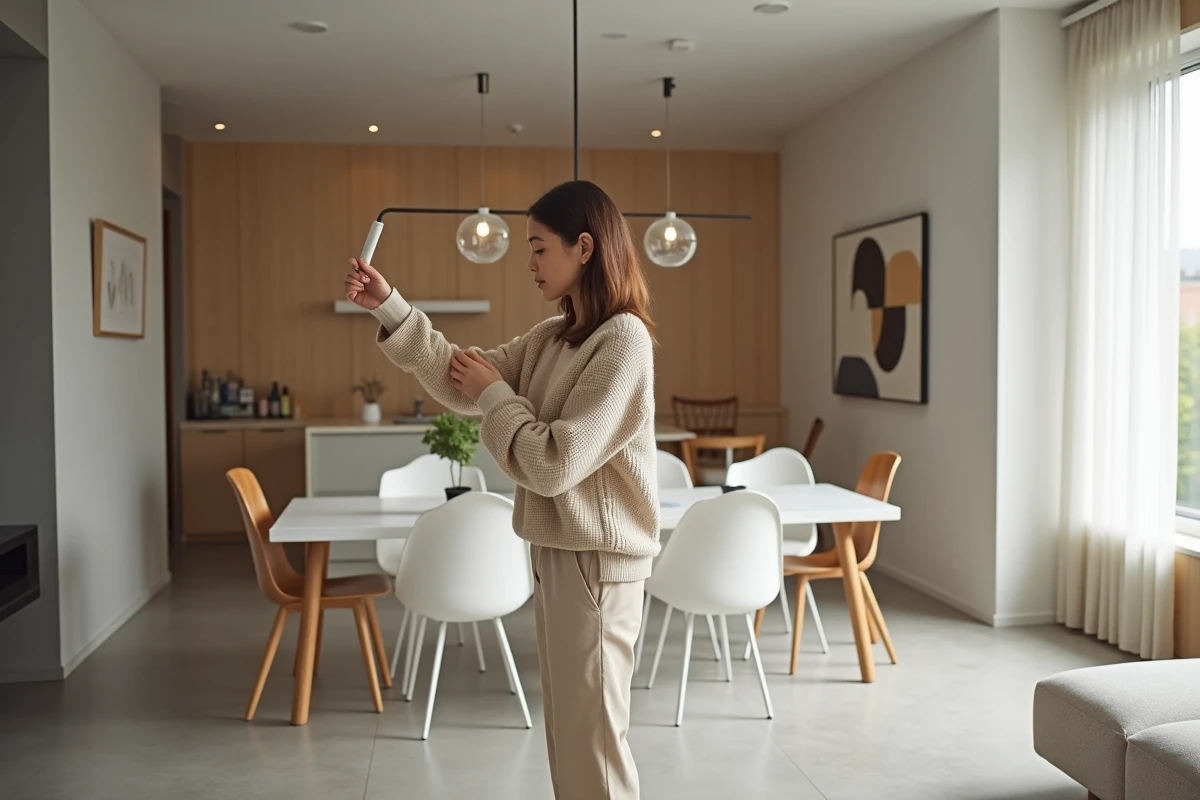
The type of fixture influences light diffusion: pendants for the living room or dining table, ceiling lights in rooms with low ceilings, recessed spots for the kitchen or bathroom, floor lamps in reading corners, and wall sconces for hallways and entries. Don’t forget to check the compatibility of the bulb base, E27, E14, or GU10, with the chosen fixture to avoid unpleasant surprises during installation.
A final detail not to overlook: ceiling height. For a dining table, hang your fixtures 60-80 cm above the surface. This adjustment enhances the volumes and ensures optimal visual comfort. Choosing LED lighting is not just about aesthetics; it’s also about considering the overall layout.

Colors, intensity, design: how to enhance the ambiance of your home with LEDs
LED lighting opens the door to a myriad of possibilities for structuring and highlighting every corner of the home. Let yourself be tempted by RGB LED bulbs, capable of transforming the atmosphere of a room in the blink of an eye: warm and comforting light for relaxation moments, bluish hues to enhance concentration, vibrant shades for friendly evenings. Adding a dimmer allows you to adjust the light according to the time or mood, from a gentle wake-up to a dimmed dinner.
For a harmonious and functional ambiance, it is wise to combine several types of lighting. Here’s how to structure your lighting:
- A central pendant diffuses a global and homogeneous light.
- Wall sconces direct light to reveal a piece of art or a bookshelf.
- Table lamps with LED filaments bring a warm and retro touch.
Adapt each fixture to the style of your room: clean and simple lines for a contemporary ambiance, raw materials for an industrial effect, or Scandinavian design for a soft light. RGB LEDs add a creative dimension, perfect for highlighting a wall, ceiling, or even a piece of furniture.
The electrical installation must be impeccable; if in doubt, consult a professional. Well-thought-out lighting reveals volumes, accentuates decor, and supports your routines while limiting the energy bill. Light is no longer merely utilitarian: it becomes the signature of your interior, capable of transforming the ordinary into the remarkable.